Varanasi Days pt1 13 March ’18
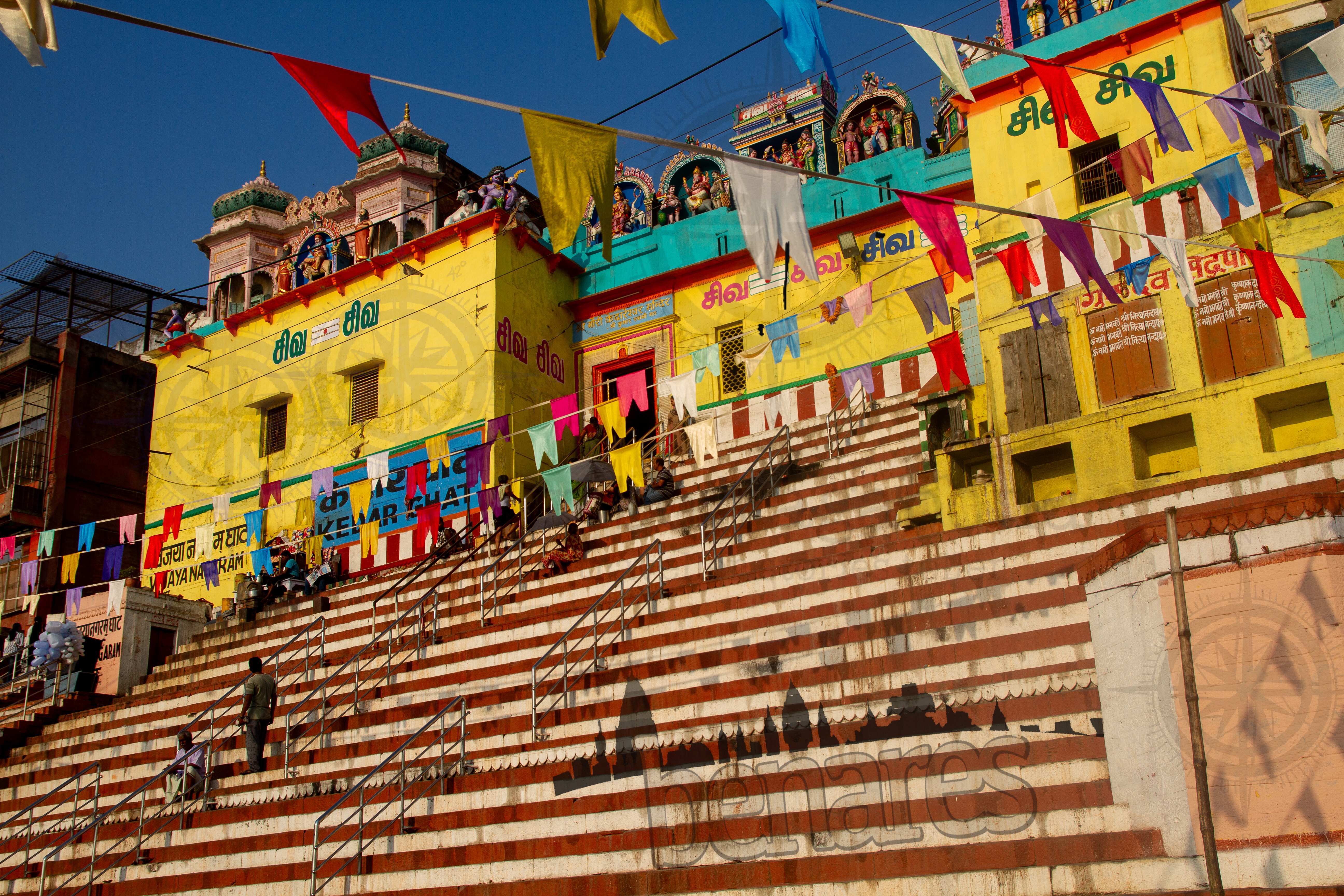
City of Bhang
Photo by me with Canon7D
Tuesday 13th /Mar/2018
~21.58 – Varanasi, Uttar Pradesh
“At last: Banares!” exclaimed cheerfully, but exhausted the old man sitting next to me as the “11071 Mumbai Kamayani Express” finally pulls in at Varanasi Junction.
It took a solid 33 hours to get here all the way from Mumbai (including an acceptable two hours 35 minutes of delay); and we’ve shared most of the 1588 kilometres. The old man, two friends of him and me.
“Indeed!” I emotionally agreed with my fellow-traveller. “So this is Varanasi, ugh?”.
Although I’m a big fun of oldies and nostalgic names, I can’t bring myself to call this city in the old fashioned way: Banaras or Benares. Or Kashi for that matter, but who cares?
What matter is that I’m finally here; and not just because the journey to get here was tremendously long and rather uncomfortable [I got the ticket with a RAC (Reservation Against Cancellation), aka waiting list, meaning that “although it ensures certainty of travel, it does not guarantee a berth”, which imply that you could end up sharing a berth with another person; and that was exactly what happened].
No, it’s not only for this reason that I’m glad to be here.
It’s mainly because I can finally see one of the oldest and holiest city in the World. An historical, mystical and fairly unreal place of which I heard so much of, and many stories about:
“It’s the oldest city of the entire World.” some people told me.
“It’s the Holiest city of the whole India.” some other people told me.
“People go crazy and lose their minds ‘cos the energy is too strong.”Or “I heard many burn their passports there”.
“People go there to die”. I was recently informed of.
“Are you dying?”. I was genuinely asked.
“People go there to die” kind of shocked me the first time I heard it. It was just two weeks ago when Danish told me.
Before that, I only heard this city to be referred exclusively as old and holy. I’ve never really thought or asked why it was so holy. But as I’m slowly starting to understand Dead has a hell of a deal to do with it.
With this new nuance, Varanasi took up a different hue. A grimmer yet fascinating one. A newer source of reflection. It definitely sparkled up even more my curiosity.
The fact that it was Danish the person who pronounced that line had even a bigger impact on me. The words felt heavier.
I can still remember the tone: “People go there to die.” As calm and natural as if he was saying something as ordinary as “what a nice weather today.” in his beautiful Indian accent.
Aaaah India.. I guess here life feels more life.. more tangible, more ephemeral, nonetheless somehow more grounded, yet so unreal. It’s hard to explain it with words. Again I believe Dead must have something to do with it.
Timing was quite spot on too.
As I like to take notes of important moment, I can tell you exactly the date and (roughly) the time when he told me that -to me- shocking sentence: Sunday the 25th of February 2018; any time between 11.30am and noon.
It was the last of the 10 days of the Vipassana retreat.
10 days of Noble Silence where I was able only to stealthy glancing at those 40 or so students and never interact with any of them in any kind of way; simply silently sharing the same space.
And Danish, out of all these people, was secretly nicknamed the Buddha. He was so elegant in his meditation, always with an incredibly straight spine, without the need of any pillows under his knees or buttocks; disciplined, never moving a muscle, or fidgeting. He was; of course, The Buddha of the course.
On that day he also told me that he was studying “meditation and the benefit of yoga”. At the University. Not on an online course. Something related to yoga-spirituality but also science and researches. I guess it’s something that could happen just here in India. So I assumed he knew a thing or two about the Holiest city of India.
“Basically they believe that if you die there you reach the Nirvana. According to Hindu religion if you are burned there and your ashes are scattered in the Holy Waters of Ganga your soul is freed from Samsara: the cycle of death and rebirth and you attain Moksha: spiritual liberation”. He wisely explained.
So that’s why it’s so holy I realised.
“Is that why are you going there? To die?” an nosy fellow-meditator curiously enquired.
I’d say that Indian are rather nosy people; after all each culture has it’s own concept of personal and privacy.
I’ve never understood if he was joking or it was honestly a genuine question; but for the little I knew him, I didn’t perceived him as a blunt, sarcastic person with a dark sense of humour. His, must have been a sincere concern. At the end of the day, as a citizen of this vast country he had probably met someone who was going to Varanasi to die. Or if he hasn’t yet, he is reasonably expecting to meet such a person sooner or later. So why not me? With hindsight, it was a legit question.
Nevertheless, it was also a funny joke; but there, at that moment, after those 10 days of deep introspective meditation, it did make me feel a bit.. uncomfortable. I might have been quite susceptible at that time. Luckily during those 10 days Goenka repeatedly called Varanasi as “The city of Bhang.”, and keeping his teachings in mind it helped me relax a bit.
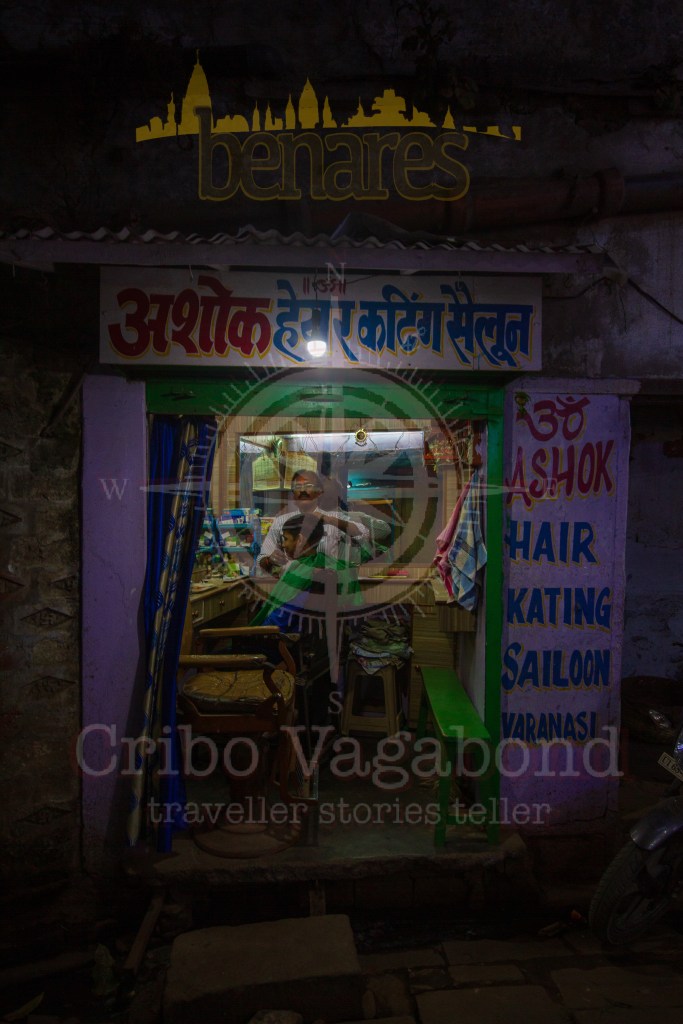
It seems that there are three main reasons to come to Varanasi: out of curiosity about the legends and rumours of this ancient sacred city; to embrace death; or, to support those who are dying. Happily, I belong to the first group.
10 pm is an intriguing hour to arrive at any station, but getting off the train and stepping onto the platforms at Varanasi Junction it’s not like getting off a train and stepping onto at any other platform at any other train station; the air is different. Maybe ‘cos plenty of trains pass through this hub. And a great deal of them are exceptionally late, causing a constant accumulation of people waiting for their arrival or departure train. Aahh.. the punctuality of the Indian’s trains; it reminds me of my own country.
Every inch available of the platform is occupied; either by casual passing through passengers or permanent local beggars, they are all waiting for something: a train or a change. Or a change of train.
People are everywhere. And all of them look terribly poor: dressed in meager yet colourful saris, or plain beige ‘dhoti’. Most of them collapsed
on the ground, huddled upon themselves, some with their suitcases, their sacks, their canvas bags, their travel bags, their walking sticks, their rags, their bells, their nothing. Lying everywhere, they seem dead; some probably are as well.
More souls are perched on the stairs or on the overpass, leaning against the cold railing, stretching a dirty hand out for some spare coins; some with a baby in their arms, some without an arm, and some without a leg.
I soldier on towards the exit, strongly downhearted by this desolation. In the waiting halls there is no difference in the scenario:
Few fortunate people sit on the handful benches or tiny walls available.
Others are parked at the little “Re-Fresh Food Plaza”; probably the most run-down food place on Earth.
Yet, most of them are cast around on the ground, using any sort of thing as a cover: their saris, old newspapers, or some thrown together rugs made with cardboard boxes (Britannia Biscuits, Tata Coffee, Imperial Leather Soap, Kwality Wall’s Ice-Cream), others are simply spread on the filthy, grimy naked floor.
Few folks queue at the ticket counter in hopes of a last minute ticket.
Outside, on the station’s front square, the sight is unchanged: people dumped and piled up everywhere: some on few chairs, most sprawled in the parking lot, or in the flower beds, surrounded by a sea of garbage: plastic bottles, disposable tea cups, food containers and any other possible trash.
I’ve never seen so much anguish and misery in one single place. After all, people come to die here in Varanasi.
Maybe that’s why it appears that nobody is in a rush. Everyone seemed to be waiting.
I said my goodbyes to the train crew: “I wish you can find what you came for! All the best!”. But once we are off the train and out in this gloomed part of the World they are no longer that talkative or friendly. “Ok.” coldly reply the old man, while two wobbles -one from each head- were all the regards the others two had to offer.
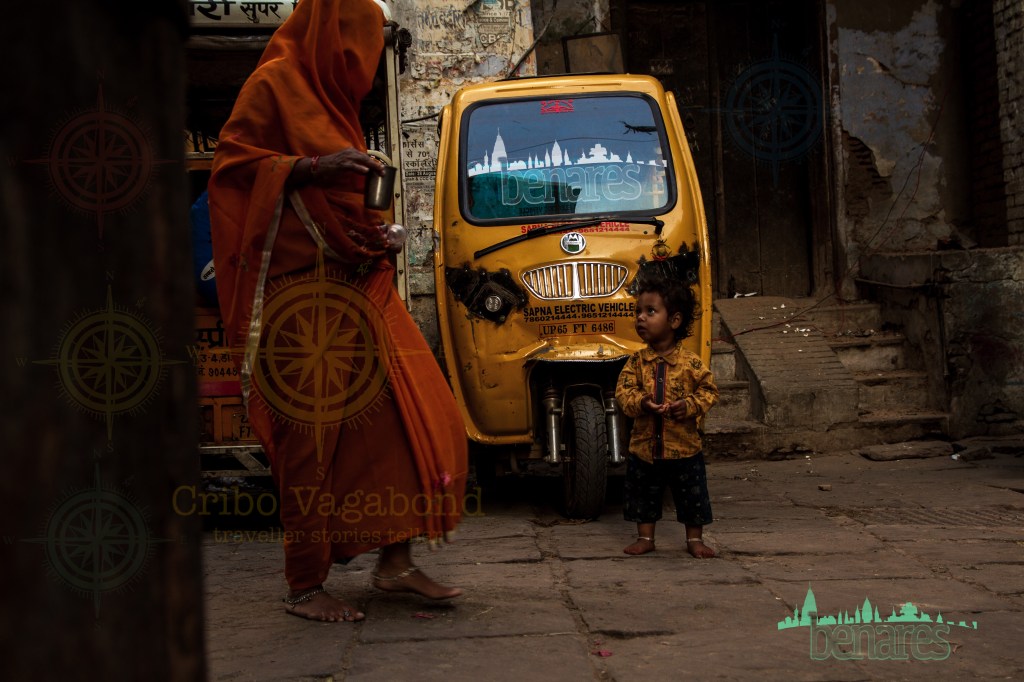
Punctual like clockwork, a rickshaw approaches me and without even turning the engine off demands “where to go?”.
No greeting or formalities are needed in such a place. Not even an “Hi”. The experienced driver knows very well that whoever arrives and finds this, want to get the hell out of there in a jiffy. He has so many potential customers out here that he doesn’t have time to waste on formalities or politeness to spear.
Mostly, I am in the need of the type of service he has to offer, plus I am rather worn-down from the long journey; so without any further ado I tell him my destination: “Stay Inn around Assi Ghat”. Before I can even finish my sentence he proudly informs me that he knows the city’s layout very well “I know Assi Ghat very well!”
He doesn’t have to finish his sentence for me to understand that he has no clue where the Inn is. “Ah! the hell with it! It’d be the same with an other driver.” I tell myself.
“How much to get there?” I ask. “250!” Bastard! I probably look terrible. “200 and we go now.” I said while placing my backpack onto the backseat. Indeed he got the right picture: not only I am too exhausted to carry on a proper, more respectable bargain, but I’m also dying for a shower and a decent bed.
Slowly but skilfully, with his Ape RickShaw, he zig-zags his way out of the parking lot among some thousands of people.
En route he exchanges few words with some friends we come across. They all are cheers and laughs, I can’t avoid thinking that he’s probably bragging about the good money he has made out this silly tourist who’s me; I knew I should have bargain for a better fare.
On the 20mins ride he fires some of the standard questions locals typically ask to visitors of this unique country: “Which country do you belong?” “Are you married?” “First time in India?”.
I intentionally reply nonsensically, using gibberish instead of real words; it doesn’t appear to be a problem to him. He doesn’t register any of my answers; he’s just pointlessly encouraging me to spit words that briefly mingle with the noise of the engine, shortly hang in the warm air before falling out of the rickshaw and get lost in the dark of the night.
Ah! I’m in love with Varanasi already.
 Cribo Vagabond